
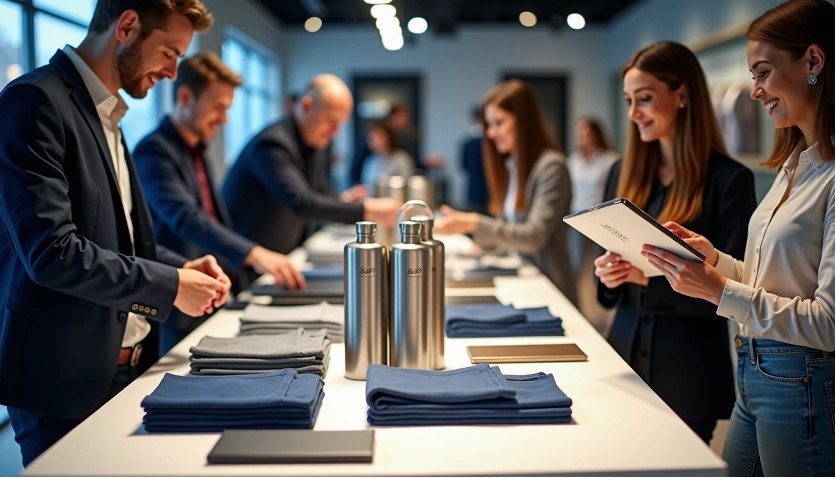
Brand merchandise can increase your revenue by up to 23%, making it one of the smartest investments for your business. Many companies overlook this powerful marketing tool, yet it consistently delivers results beyond traditional advertising methods.
Additionally, branded merchandise creates a genuine sense of belonging among customers, staff, and fans. We’ve seen how certain businesses develop almost cult-like audiences eager to purchase their branded items. In fact, compared to other forms of advertising, business merchandise offers remarkable cost-effectiveness. With a relatively small investment, your branded products can continuously promote your business long after initial distribution, generating significant returns over time.
Throughout this guide, we’ll explore how to research your merchandise goals, build a strong brand identity, design products your audience will love, and effectively distribute your brand merchandise. Whether you’re looking to launch a brand merchandise store or simply exploring brand merchandise ideas, this comprehensive approach will help you unlock the full potential of merchandise for your business.
Research and Set Clear Merchandise Goals
Successful brand merchandise starts with proper research and clear goals. If you treat promotional merchandise as the communication medium it has become, you’ll see significantly better results from your investment.
Understand your audience and their preferences
The first step to effective merchandise strategy is understanding who will receive your branded items. According to studies, 88% of consumers remember the business name from promotional products they receive. This recall power makes audience analysis crucial.
Collect both demographic data (age, gender, location) and psychographic insights (interests, values, lifestyles). Different audience segments warrant different merchandise approaches – what works for event attendees won’t necessarily appeal to VIP clients.
Ask yourself: Are your customers tech-savvy young people or environmentally conscious professionals? What do they need daily? Understanding these preferences helps select products they’ll genuinely appreciate rather than discard.
Study competitors and market trends
Examining your competition provides valuable insights into what works in your industry. Through competitor analysis, identify what merchandise strategies they’re implementing, how they position their branded products, and what seems to resonate with shared audiences.
Look at competitors’ merchandise offerings, pricing strategies, and marketing approaches. This research helps you:
- Benchmark against industry standards
- Discover untapped niche opportunities
- Identify ways to differentiate your merchandise
Moreover, staying current with merchandise trends ensures your branded items remain relevant without losing your core identity. The old “logo-slap” approach of branding generic items without thought is rapidly fading.
Define your merchandise objectives
Setting clear, measurable objectives transforms vague intentions into trackable results. Effective merchandise goals should connect directly to your broader business objectives.
Instead of simply saying “increase brand awareness,” tie your goals to specific metrics like website visits, social media engagement, lead generation, or customer retention. For example, if your aim is increasing brand recognition, choose items people use frequently that will be seen by others.
Using the SMART framework (Specific, Measurable, Achievable, Relevant, Time-bound) helps create merchandise objectives that drive real business value. This structured approach ensures your branded products work strategically rather than just serving as random giveaways.
Build a Strong Brand Identity for Merchandise
The foundation of compelling brand merchandise lies in a strong, cohesive identity. When your branded items reflect your company’s essence, they become powerful ambassadors that customers actually want to use and display.
Clarify your brand values and tone
Your merchandise tells a story about your business. Before designing products, clearly define what you stand for. Studies show that 46% of consumers research brand values while shopping in stores and 49% do the same online. Furthermore, consumers are four to six times more likely to purchase from purpose-driven companies.
Consider how you want people to perceive your business—professional, creative, edgy, or inspiring. This personality should be consistent across all branded items. When merchandise aligns with your core values, it creates genuine emotional connections; consequently, 84% of consumers become more loyal to value-aligned brands.
Design a consistent visual identity
Your visual identity encompasses all elements that bring your brand to life visually. This includes your logo, color palette, typography, imagery, and illustrations. Nevertheless, it’s more than just design—it’s also the documentation ensuring these elements are used consistently across all touchpoints.
For successful brand merchandise, establish a centralized system where all visual guidelines are accessible. This enables everyone creating branded materials to maintain consistency, whether designing one item or an entire merchandise line.
Ensure logo and colors work across products
When adapting your logo for merchandise, consider both the design and material of each product. Pay attention to size, placement, and how different printing techniques (screen printing, embroidery, laser engraving) affect appearance.
Colors evoke specific emotions and work at a primal level to signal your brand’s personality. Most successful logos use two or three distinct colors—typically one primary color and one or two accent colors. Ultimately, ensure your visual elements maintain legibility and impact regardless of the merchandise item they appear on.
Choose and Design the Right Merchandise
Selecting the right products forms the heart of any successful merchandise strategy. The items you choose become physical representations of your brand essence and values.
Popular brand merchandise ideas to consider
Apparel remains among the most effective promotional products, with t-shirts ranking in the top three for impact and capable of increasing referrals by up to 500%. Other popular options include:
- Everyday essentials: Mugs, water bottles, and tote bags offer daily visibility and practical value
- Tech accessories: Phone cases, power banks, and mouse pads provide functional benefits for tech-savvy audiences
- Wearable items: Caps, beanies, and socks create walking advertisements while serving practical purposes
Balance function with brand appeal
Successful merchandise finds the sweet spot between usefulness and brand representation. Studies show 80% of consumers prioritize practicality when evaluating branded items. Meanwhile, 41% want merchandise that feels unique. This balance ensures your products remain in regular rotation rather than forgotten in drawers.
Avoid low-quality or irrelevant items
Cheap or poorly made merchandise can damage your reputation. Low-quality products reflect poorly on your brand and suggest you don’t value customer relationships. Similarly, avoid items with no connection to your company’s identity or audience needs. For instance, fragile glass items at an outdoor festival create negative associations.
Work with designers or use DIY tools
Professional designers bring expertise in creating merchandise that aligns with your brand identity. They understand printing techniques and material limitations. Alternatively, platforms like Canva offer intuitive tools for creating custom designs without design expertise. These options let you customize everything from t-shirts to mugs within minutes.
Test with sample runs before full production
Never skip sample testing before full production. Order small batches first to inspect quality, print clarity, and durability. This step prevents costly mistakes and ensures your promotional products meet expectations. Garment samples specifically help verify fit, materials, and overall appearance.
Distribute and Promote Your Merchandise Effectively
Image Source: Brafton
Creating exceptional merchandise is only half the battle; how you distribute and promote it determines its ultimate impact on your brand success.
Use giveaways, bundles, or direct sales
First, consider various distribution methods to get your merchandise into the world:
- Employee events and trade shows help potential customers remember your company
- Loyalty program rewards commemorate milestones and incentivize program sign-ups
- Contests and social media giveaways drive engagement while distributing merchandise
- Customer gifts alongside purchases incentivize bigger orders
For online stores, implementing smart product bundling can increase average order value by as much as 30%. The key to successful bundling is making the value proposition so strong that choosing individual items feels like a missed opportunity.
Leverage online and offline distribution channels
Despite e-commerce popularity, 80% of retail purchases still happen in-store. This makes an omnichannel approach essential for merchandise distribution.
In physical stores, leverage QR codes that allow customers to enter contests or access exclusive merchandise. Health-Ade’s Grocery Sweeps drove over 80,000 in-store QR code scans resulting in 40,000 entries. Subsequently, distribute branded products at events to create buzz and attract potential customers.
Promote through social media and email
Social media is extraordinarily effective, with 3.5 billion active daily users across generations. Video marketing particularly stands out, generating 1,200% more shares than text and image content combined.
Above all, consider partnering with micro-influencers rather than celebrities. These smaller influencers often have highly engaged audiences more likely to try your products and share their experiences.
Encourage user-generated content
User-generated content builds authenticity, with over 90% of consumers trusting UGC more than traditional advertising. Run UGC challenges where customers post pictures wearing your merchandise in exchange for features on your page.
Track performance and gather feedback
To improve future campaigns, consistently monitor key metrics like engagement rate, hashtag usage, and conversion rates. Use high-engagement channels like WhatsApp, with its 98% open rate, to gather valuable customer feedback.
Conclusion
Branded merchandise stands as one of the most powerful yet underutilized marketing tools available to businesses today. Throughout this guide, we’ve seen how strategic merchandise can boost your revenue, foster customer loyalty, and extend your brand reach far beyond traditional advertising methods.
Research proves essential before launching any merchandise initiative. Understanding your audience, analyzing competitors, and setting clear objectives transforms random giveaways into strategic assets that drive measurable results. Your branded items tell a story about your business, therefore aligning them with your core values creates authentic connections with customers.
Quality matters significantly when selecting merchandise. People remember brands from useful, well-made promotional products they interact with daily. Consequently, choosing items that balance functionality with brand appeal ensures your merchandise remains in regular use rather than forgotten in drawers.
Distribution strategy ultimately determines your merchandise campaign’s success. Whether through giveaways, direct sales, or loyalty rewards, getting your branded items into the right hands amplifies their impact. Social media promotion, user-generated content, and performance tracking further maximize your return on investment.
Branded merchandise offers remarkable cost-effectiveness compared to other marketing strategies. A relatively small investment creates walking advertisements that continuously promote your business long after initial distribution. This enduring visibility, coupled with the emotional connection merchandise fosters, makes it an indispensable component of any comprehensive marketing strategy.
The next time you consider ways to strengthen your brand and boost sales, remember the untapped potential of well-executed merchandise. After all, when done right, your branded products become more than just items—they transform into powerful ambassadors that customers proudly use, display, and share.